Pixels vs. Prosthetics: How Modern Horror Actually Builds Its Ghosts
There's a moment in almost every modern ghost movie where you know exactly what you're looking at. Not a spirit. Not a presence. A render. Something that was built inside a computer by a team of talented people who, despite their best efforts, produced something your brain quietly refuses to believe in. It happens fast — one frame the tension is real, the next you're mentally pricing out popcorn refills.
That's the central problem haunting contemporary supernatural cinema, and it's worth understanding why it happens, how filmmakers are fighting back, and which approach is actually winning the war for your nervous system.
The Promise and the Problem with Digital Ghosts
CGI spirits opened up a genuinely exciting creative frontier when they started appearing in mainstream horror around the late '90s and early 2000s. Suddenly, you could show a ghost doing things no actor in a latex suit could manage — moving through walls with fluid grace, decomposing in real time, manifesting as something genuinely inhuman. The technology felt limitless.
But audiences adapted faster than studios expected. Human brains are remarkably good at detecting when something isn't quite right about a face or a body in motion. That sensitivity — the uncanny valley effect, first described by roboticist Masahiro Mori — turns out to be a major liability when you're trying to sell fear. A ghost that looks almost real but doesn't move quite right doesn't read as terrifying. It reads as fake. And fake is the one thing horror can't survive.
VFX artists working in the genre have been dealing with this tension for years. The core challenge, as several have described it in industry interviews, is that ghosts are supposed to be wrong. They're supposed to violate the rules of how bodies look and move. But there's a difference between intentionally wrong and accidentally wrong — and audiences can feel that difference even if they can't articulate it.
What Practical Effects Actually Do to an Audience
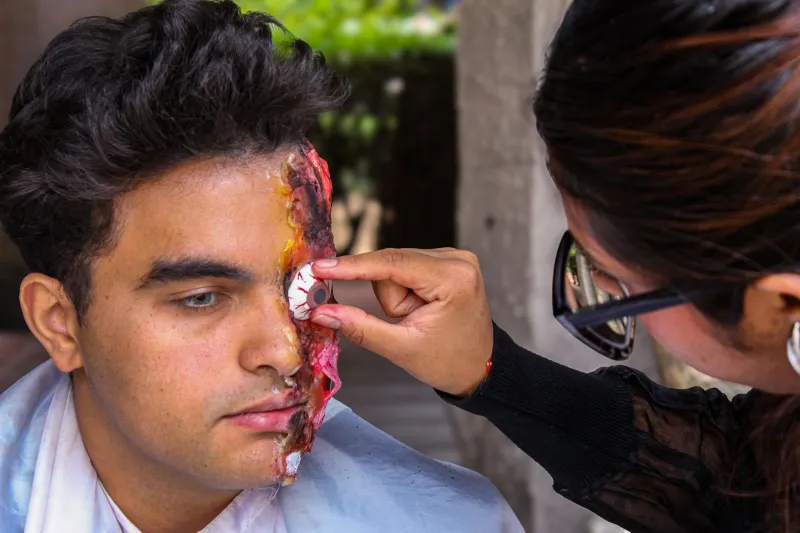
Practical effects work on a different level entirely. When a performer is wearing full prosthetic makeup, moving through physical space with real weight and texture, something clicks in the viewer's nervous system that no render can fully replicate. You're watching a real thing. It exists. It's in the room.
The legacy of practical ghost and creature work in American horror is genuinely impressive. Productions that leaned hard into physical effects — think the drowned, waterlogged appearances in films like The Ring or the contorted physicality of possession sequences built around real stunt performers — created images that stayed with audiences for decades. There's a reason those visuals still circulate as cultural touchstones. They were built from something tangible.
Makeup and prosthetics also give actors something to react to. When your lead performer is genuinely staring at a seven-foot practical creature instead of a green tennis ball on a stick, their fear tends to register differently on screen. That authenticity compounds — the actor's reaction sells the threat, the threat sells the scene, and the audience never gets pulled out of the experience long enough to start second-guessing what they're seeing.
Where CGI Actually Wins
None of this means digital effects are the enemy. Used strategically, CGI does things practical work simply can't — and in ghost cinema specifically, that matters.
Environmental hauntings benefit enormously from digital tools. A house that breathes, shadows that pool and move against the light source, reflections that don't match the person casting them — these are effects that live in the peripheral vision of a scene, and they work precisely because they're subtle. The viewer's brain registers something wrong without fully identifying what it is. That's a powerful trick, and it's almost entirely a digital one.
Recent productions have also gotten smarter about using CGI to extend practical work rather than replace it. A performer in full prosthetic makeup gets photographed on set, and digital tools are used to enhance specific movements or add environmental interaction that would be physically impossible. The underlying reality anchors the effect; the computer work amplifies it. The results tend to be significantly more convincing than either approach in isolation.
The Uncanny Valley Is Specifically Brutal for Ghosts
Here's the wrinkle that makes supernatural cinema uniquely difficult: the uncanny valley problem is worse for ghosts than for almost any other type of creature effect.
Monsters, aliens, demons with genuinely non-human anatomy — audiences give those a wider margin. They're not supposed to look like people, so deviations from human movement and texture read as intentional. Ghosts, though, are almost always former humans. They carry the memory of a person. That means viewers are applying the same perceptual standards they use to evaluate real human faces and bodies, and any slip in fidelity gets flagged immediately.
This is why a lot of the most effective ghost designs in recent American horror have deliberately moved away from humanoid rendering. Apparitions that appear as light, as sound, as environmental disturbance — these sidestep the uncanny valley entirely because there's no human template to compare them against. The audience's imagination fills in the rest, and imagination is almost always scarier than anything a VFX team can build.
What the Best Ghost Movies Are Doing Right Now
The productions getting this right tend to share a few common instincts. They're using CGI for suggestion and practical work for revelation — building dread digitally, then paying it off with something physical and present. They're resisting the impulse to show the ghost in full detail, understanding that a half-seen thing in the corner of a frame does more psychological damage than a fully rendered specter center-screen. And they're trusting their performers to carry the weight of the audience's fear, using effects to support performance rather than substitute for it.
There's also a renewed appreciation in the industry for what low-fidelity can accomplish. Degraded image quality, motion blur, compression artifacts — these are techniques borrowed from found footage that have migrated into more traditional supernatural filmmaking. A ghost that appears in a damaged frame, or through a dirty window, or in the background of a shot that's slightly out of focus, benefits from the same principle that makes practical work effective: it feels like evidence of something real.
The Verdict for Ghostheads
If you're watching a ghost movie and something sends a genuine chill up your spine, odds are there's a practical element somewhere in that effect — even if the finished image looks entirely digital. The best VFX work in supernatural cinema right now is hybrid work, built on a foundation of physical reality and extended by digital tools that know when to stay out of the way.
Pure CGI ghosts can be impressive. They can be visually inventive. But impressive and terrifying aren't the same thing, and the films that understand that distinction are the ones leaving audiences genuinely unsettled long after the credits roll.
The dead are most convincing when they were built from something real. Hollywood is slowly remembering that.